I Made an Exoplanet Webapp
And I Learned How to Use R Shiny in the Process
Interest
One of my favorite photos I've ever taken was on a trip to Bolivia with my roommate and friends: the view from the final El Alto stop on Mi Teleférico. I believe this is the Vista de la Línea Amarilla (yellow line), though to be perfectly frank I don't remember which color line takes you there.
I have a lot to say about that trip, the fascinating cities of La Paz and El Alto, and that image, but for now I'll just say this: it's one of those views that reminds me we live on a planet in space. To conjure a similar feeling you can always image-search "surface of Mars" and "Canyonlands National Park" in two different browser tabs and then rapidly flip back and forth between them. I also love to look at the old Soviet photos of the surface of Venus.
I had the pleasure of attending a lecture on exoplanet detection by the astronomer Meg Urry in 2013 or 2014, and was floored by how the number of exoplanet candidates has exploded in recent years. As I tried to contextualize the sheer number of planets out there, I realized (maybe this is obvious to everyone) that all rocky planets have a surface you can stand on, though who knows for how long. Any planet that has or had an internal dynamo probably has mountains, and any planet that orbits close enough to a star probably has visible light. There are places billions of light years away where you could perform the seemingly so-human act of standing and marveling at a mountain. Maybe, out there, someone is.
Background
Exoplanet discoveries (a planet that orbits a star other than the sun) are exciting because each new one could be the planet on which we discover extraterrestrial life. In aggregate, the tremendous success of exoplanet search projects suggests that exoplanets might be common among stars in the universe. The likelihood that life even remotely similar to life as we know it exists elsewhere is a function of how likely life-supporting planets are to form around a given star. The search for and study of exoplanets is therefore critical to our understanding of our place in the universe.
The search has just begun. The first exoplanet was confirmed only in 1992, and only recently have modern, prolific search methods been developed. Research teams use various techniques to find candidate objects, then review them and determine whether they can reasonably be sure the object is a planet. Then the planet is added to the list of confirmed exoplanets, which can be found at exoplanet.eu — the source of my data for this project.
App
I created a Shiny app to visualize some of the properties and methods of discovery of the ~4,000 exoplanets discovered to date. I envision it as an educational tool that invites the user to question the meaning of the data and instills a sense of excitement about exoplanets. See the app here.
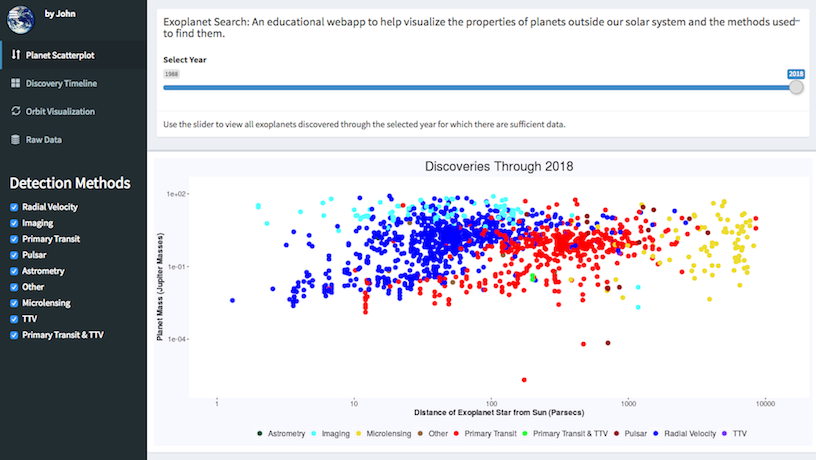
The first page contains a large scatter plot of most of the exoplanets, with distance from earth and mass as the log-scale axes. The points are colored to show which method was used to discover each exoplanet. The user can move a slider to show all discoveries through a given year; moving it helps one understand the magnitude of the exoplanet explosion in recent years. The coloring shows that certain methods seem to be better at discovering very distant planets or less massive ones. Some internet searching shows that this is true. For instance, the Kepler mission discovered many smaller, earth-like planets that were confirmed in 2014 using the transit method. The transit method involves measuring drops in a star's brightness caused by an object regularly passing in front of it, like a planet. It requires a powerful telescope and can detect smaller planets than microlensing, which measures light distortion due to distant, massive objects.
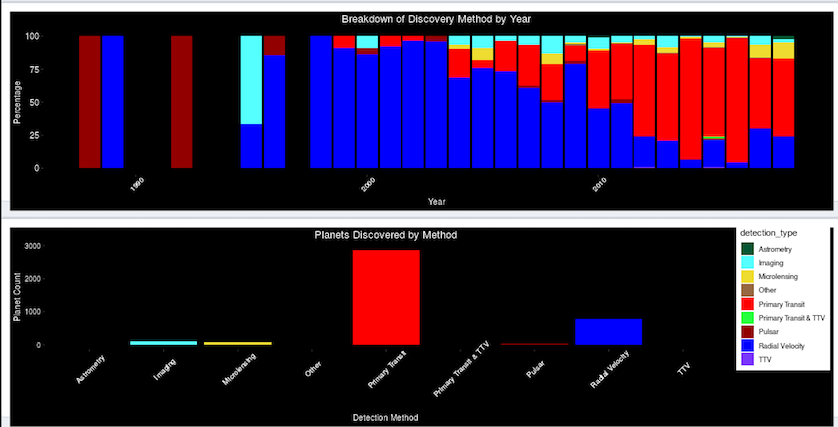
The second page contains two graphs showing the productivity of each method by year and overall. Users can hide data from any method using checkboxes in the sidebar, and the graphs readjust. Each method retains the color it had on the scatter plot on the previous page, regardless of which methods are "turned off." I learned that you can assign colors to specific categories in ggplot2 — regardless of filtering some out — by passing a named vector to the color argument when creating the graph.
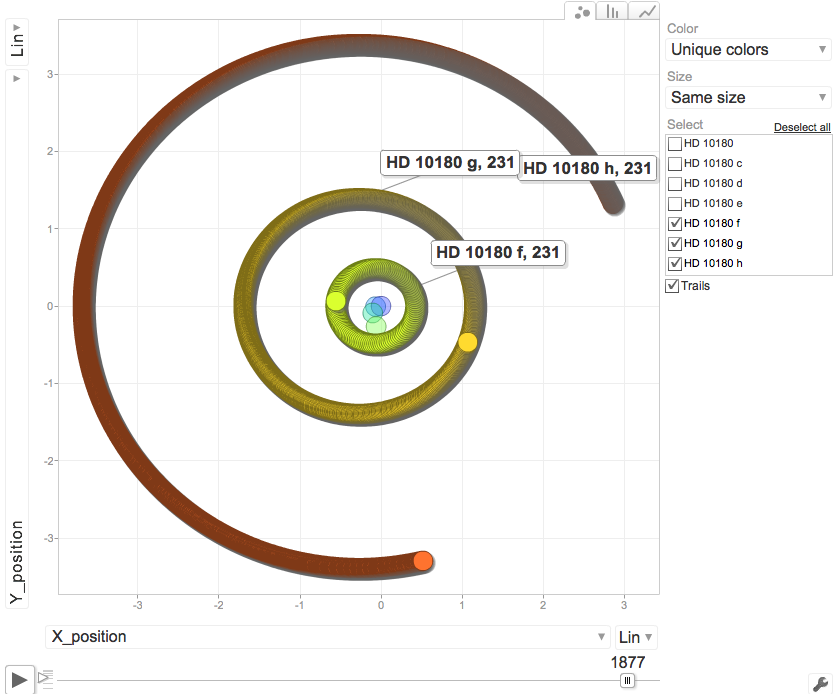
The next page lets the user visualize the orbits of the planets. You can select a star from a dropdown menu, and a widget shows the path of all the planets that orbit that star over 2,000 earth days. I think this page brings the exoplanets to life, and I hope it inspires users to learn more about orbital mechanics and the planets themselves. The shape and speed of the orbits are correct. If multiple planets orbit the same star, the orbits may be offset from one another; there isn't enough data to compute that offset, so I assumed none. I used Kepler's laws to compute the path of each planet given the semi-major axis and eccentricity of its orbit. It was difficult to get the widget — generated by the GoogleVis Motion Chart — to work properly with R Shiny; among other adjustments, I used the htmlOutput function instead of plotOutput. Take a look at the code repo.
A note from later: the orbit visualization relied on Adobe Flash, which browsers no longer support, so that page of the live app no longer animates.
Future Work
I hope to improve the project in a few ways. Making the first page's slider a two-point slider could add usability by letting the user see any time period's discoveries, instead of just to-date discoveries. I'd also like some way to see the number of discoveries in a given year. And I may change the first graph on the second page to a stacked graph of the number of planets discovered by method, rather than the percentage of discoveries by method.
Thanks!
If you enjoy my app or have any feedback for me, please email me. Thanks!